Chicken Salad Chick
- 4.8
- Rating
- 500.00K
- Installs
- Free
- Price
 Analysis by App-foxy
I approached Chicken Salad Chick as a practical companion for ordering from the restaurant and keeping track of its rewards, rather than as a general lifestyle app. That distinction matters. Its purpose is quite focused: make repeat visits easier, let me collect points, and give me a place to redeem rewards while ordering online. In my experience, that narrow scope is both its biggest strength and its clearest limitation.
The app is free, aimed at Everyone, and developed by Chicken Salad Chick. It has built a strong presence on mobile, with over 500 thousand installs, an average rating of 4.8 from around 19 thousand ratings, and roughly 2.6 thousand written reviews. Those figures suggest that many customers find it useful, although popularity alone is not a substitute for checking how comfortable you are with creating an account and using a restaurant-branded ordering tool.
What the app is really for
The central idea is simple: I use the app when I already intend to buy from Chicken Salad Chick, not when I am looking for recipes, meal planning, restaurant discovery, or broad lifestyle advice. The Lifestyle label describes its general placement, but the actual experience is much more specific. It connects the restaurant visit, the rewards program, and online ordering in one mobile space.
You May Also Like

 Blood Strike: 2.5 Anniversary
Blood Strike’s Loadouts Turn Every Drop Into a Tactical Gamble
A close look at Blood Strike’s custom loadouts: how fast access to signature weapons reshapes its battle royale rhythm, rewards preparation, and narrows the gap between fights.

 Pandora - Music & Podcasts
Pandora’s Music Is Easy to Start, but Harder to Recover
Pandora’s strength is its low-effort path from a seed to a station. Its weak spot is how much confidence it asks you to place in connection, setup, and quiet recovery.

 8 Ball Pool
 Is Built on Rivalries, Rematches, and Routine
A close look at the rivalries, rematches, shared routines, and unanswered safety questions that turn a quick pool match into a persistent mobile community.

 Samsung Music
’s Quiet Strength Is Playing What You Already Own
Its reach comes less from spectacle than from dependable access to a personal library. That simplicity is both the app’s strongest retention engine and its ceiling.

 AccuWeather: Weather Radar
AccuWeather Review: A Quick, Clear Forecast for Everyday Decisions
For everyday plans, the best forecast is the one you can understand quickly. AccuWeather makes rain timing, radar, and local conditions easy to act on, with a few trade-offs.

 Hill Climb Racing
Why Hill Climb Racing Still Turns Crashes Into One More Run
A tiny car, a bumpy hill and one more upgrade: Hill Climb Racing keeps resurfacing because its simple chaos makes every near-miss feel personal.
More From Our News Desk
View All News


That focus makes the app easier to understand than many restaurant applications that try to combine news, menus, delivery, promotions, store locators, loyalty schemes, and social content. Here, the useful question is whether you visit this particular restaurant often enough for the reward system and ordering convenience to justify another app on your phone.
I would not install it simply because it is free. I would install it if Chicken Salad Chick is already part of my routine, especially if I tend to place the same kind of order. Occasional customers may find the app less valuable because the benefit depends on returning to the same brand and making the loyalty features part of the purchase process.
The current release is version 4.2.23, and it supports devices running Android 7.0 or later. That gives it a reasonably broad compatibility range for Android users, although device performance can still vary depending on the phone, operating-system condition, and connection quality. The app is also available as a mobile ordering experience rather than something that requires a desktop browser, which is useful when I am deciding what to pick up while away from home.
A realistic lunch routine
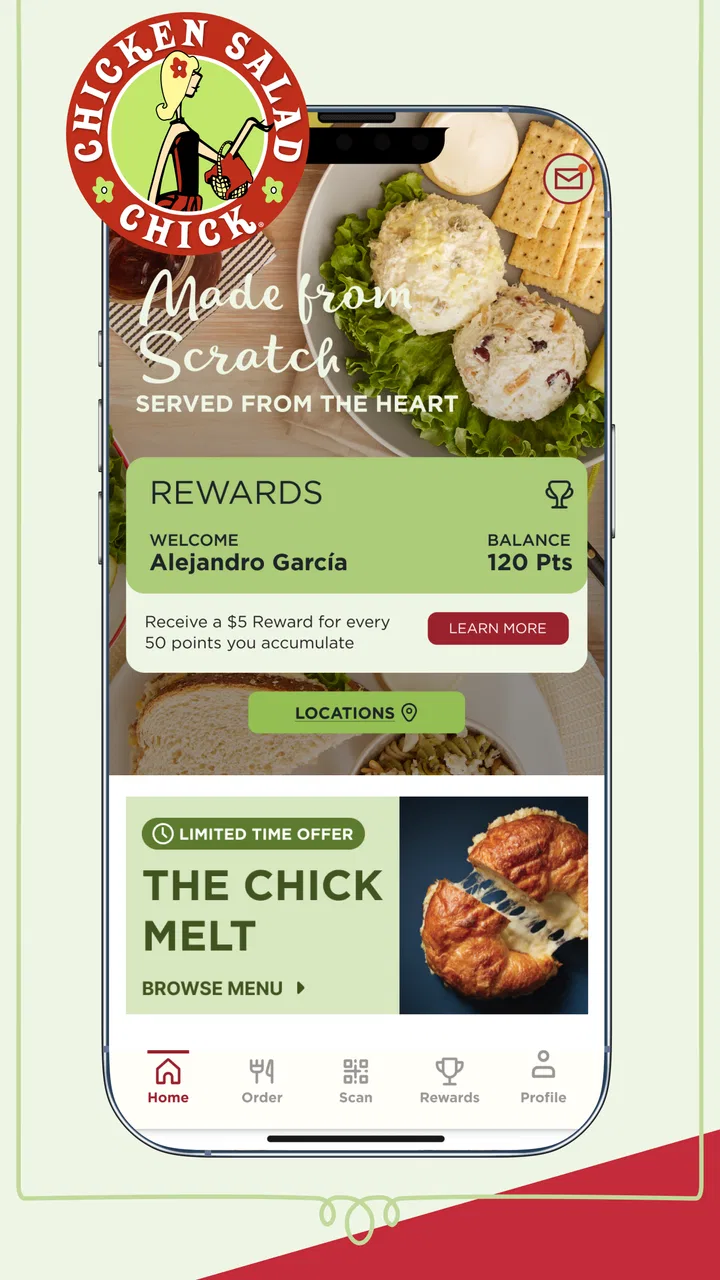
Imagine a weekday when I am leaving work and want to order the same lunch I have bought before. Instead of opening a browser, searching for the restaurant, and starting from scratch, I can open the restaurant app, review the available ordering path, and check whether my accumulated rewards are relevant to that purchase. The best part of that workflow is not that it transforms lunch; it reduces small points of friction when I already know where I want to eat.
There is a practical habit that makes the experience more reliable: I would check the reward balance before building the order, then decide whether to redeem something now or save it for a later visit. That prevents me from treating the reward as an afterthought at checkout. It also makes the loyalty feature feel like a planning tool rather than a decorative section that I rarely open.
Another useful habit is to use the app for repeat orders only after reviewing the current selection carefully. Familiarity can make me move too quickly, especially when I assume that a previous order will be available in exactly the same form. A quick review of the order before submitting it is worthwhile, because convenience should not replace attention.
Rewards are useful only when they fit your habits
The promise of earning points and redeeming rewards sounds straightforward, but the real value depends on how often I return and how consistently I use the same loyalty account. If I visit only once in a long while, the app may feel like an extra step: install it, remember the account, open it during a purchase, and then wait for the rewards to become meaningful.
For a regular customer, the calculation is different. The app gives that person a dedicated place to keep the loyalty activity connected to ordering. I find this more practical than relying on paper receipts or trying to remember a rewards number at the counter. The trade-off is that the convenience comes with account-related responsibility. I need to keep access to the account and pay attention to which account is active when making a purchase.
I also recommend deciding in advance how you want to use rewards. Saving every reward may sound sensible, but it can make the program feel distant. Redeeming every available reward immediately may be satisfying, but it may not suit a larger planned order. The app is most helpful when I treat points as part of my eating routine and not as a reason to buy food I did not want in the first place.
Trust begins with the choices I can see
Because this app is connected to ordering and rewards, I look at it differently from a simple menu viewer. The important trust questions are practical: what account information I am asked to provide, which choices are visible during sign-in and ordering, how clearly the app presents the next step, and whether I can control my participation in the loyalty experience.
I do not treat a high rating as proof that every privacy or account question has been answered. A strong average rating tells me that the overall experience has worked well for many people, but it does not remove the need to read screens carefully. When an app handles a restaurant order, I want to know what I am confirming before I submit it, whether I am signed into the intended account, and whether a reward has actually been applied.
The most trustworthy approach is to make deliberate choices rather than tapping through quickly. I would review account prompts, examine the order summary, and avoid entering information into a profile that I do not plan to use. If the app presents optional communications or promotional choices, I would treat them as decisions rather than automatic parts of ordering. That is not a criticism of this specific app; it is the sensible way to use any brand-linked loyalty tool.
There is also a difference between an app being convenient and an app being necessary. Chicken Salad Chick’s app may make the brand’s ordering and rewards process more manageable, but I should not assume that installing it is required for every visit. If I prefer to order in person or use a different established ordering method, that preference is valid. The app earns its place when its controls and workflow are more useful to me than those alternatives.
Account control deserves attention
My main caution is that loyalty convenience can encourage people to create an account without thinking about how they will manage it later. Before signing up, I would use an email address I can access reliably, choose a password I do not reuse elsewhere, and make sure I understand which account receives the points. If more than one person in a household uses the restaurant, agreeing on one account or keeping accounts separate can prevent confusion.
That household situation is a less obvious source of friction. A shared phone, a family member placing an order, or switching between personal accounts can make it unclear where rewards belong. I would avoid casually logging out and into different accounts during a busy ordering moment. A few seconds spent checking the active account can prevent disappointment when points or rewards do not appear where I expected.
I would also keep a record of the order confirmation shown inside the app or on the final screen, without assuming that a reward balance alone proves every transaction was handled correctly. If something looks wrong, having the relevant order details available makes it easier to explain the problem through the restaurant’s support route. This is a simple workflow improvement, but it is more useful than merely trusting that every tap succeeded.
Data-sensitive moments during normal use
The moments that deserve the most attention are the ones where I move from browsing to action: creating or accessing an account, placing an order, selecting a reward, and confirming the purchase. I slow down at those points because they connect the app to a real transaction. A menu screen can be casual; a final order confirmation is not.
I would avoid using a public device or leaving the app open on a shared phone after ordering. Even when the app feels familiar, an account-based service should be treated as personal. Locking the phone and signing out when appropriate are small steps that preserve control, especially if another person might use the device.
I also prefer to keep notifications purposeful. If the app offers notification choices, I would select only the types of messages that help me, such as information related to an order or rewards, and avoid enabling everything automatically. The goal is not to block all communication; it is to make sure the app remains useful instead of becoming a stream of prompts that I stop reading.
When I am on a limited mobile connection, I would prepare the order before reaching the restaurant rather than waiting until the last moment. This is not only about speed. A rushed checkout makes it easier to overlook the selected location, the reward choice, or the order details. A stable connection and a calm review are better safeguards than assuming the app will correct every mistake.
Where it beats the usual alternatives
Compared with ordering in person, the app can be more convenient when I already know what I want and would rather arrange the order before arriving. It gives me a dedicated place to combine loyalty activity with the purchase, which is harder to manage when I rely only on memory or a physical receipt. For repeat customers, that can be a meaningful improvement.
Compared with using a general delivery or restaurant-search service, the brand-specific app has a clearer relationship with Chicken Salad Chick’s own rewards experience. A third-party service may be preferable when I am comparing several restaurants, coordinating multiple orders, or looking for broader delivery options, but it may not provide the same focused loyalty workflow. The better choice depends on whether I value restaurant comparison or brand-specific convenience in that moment.
Compared with a mobile browser, the app may feel more direct because it is already installed and designed around the restaurant’s ordering path. The browser can still be the better option for someone who visits rarely, has limited storage, or does not want another account-based app. I would not call the app automatically superior; I would call it more suitable for a repeat customer who wants a persistent mobile routine.
One trade-off is that specialization reduces flexibility. This is not a universal food-ordering tool, and it does not replace a broader service when I am exploring local choices. Its value rises as my preference becomes more specific. If I am asking, “What should I eat nearby?” I would look elsewhere. If I am asking, “How can I make my next Chicken Salad Chick order and reward use simpler?” this app is more relevant.
Who should use it, and who should skip it
I think it is a good fit for regular Chicken Salad Chick customers who want online ordering and a loyalty account in the same place. It is also suitable for people who tend to repeat purchases and appreciate checking rewards before deciding whether to order. The free price removes one obvious barrier, although the app still costs time and attention to set up properly.
I would recommend skipping it if you rarely visit the restaurant, dislike creating accounts for individual brands, or prefer to keep all food orders inside one general service. It is also not the right choice for someone looking for nutrition planning, recipe inspiration, or a broad lifestyle companion. The category label should not create that expectation; the useful experience is tightly connected to this restaurant.
Families and frequent office-order groups should think about account ownership before adopting it. A single shared account may appear convenient, but it can blur who made a purchase and who should receive the benefit. Separate personal accounts may be cleaner, while one designated account may work for a household that intentionally combines its loyalty activity. The important point is to choose a method rather than letting the app’s login state decide accidentally.
My cautious verdict after using it
Chicken Salad Chick succeeds because it concentrates on a clear job: connecting online restaurant ordering with points and rewards. I appreciate that focus. When I already want food from this brand, the app can make the process feel more organized than switching between a browser, a receipt, and a separate memory of my loyalty balance.
My praise comes with a boundary. The app is not essential for every customer, and its convenience should not encourage careless account creation or rushed checkout. I would use it with a deliberate routine: keep the account secure, check the active profile, review the order, confirm the reward choice, and control any optional communication settings that appear during use.
The developer, Chicken Salad Chick, has kept the product accessible as a free Lifestyle app with an Everyone rating, and its broad Android compatibility helps it reach many existing customers. Still, the right decision is personal. Choose it for repeat visits and a focused rewards workflow, not because every restaurant customer needs another app.
For me, the final judgment is positive but selective. I would recommend it to a friend who regularly eats at Chicken Salad Chick and wants a straightforward way to handle points and online orders. I would point occasional visitors toward the ordering method they already trust. That balance is what makes the app worthwhile: it is a practical brand companion when it matches my habits, but not a universal replacement for every way of ordering food.
FAQs for Chicken Salad Chick
01What is the Chicken Salad Chick app used for?
The Chicken Salad Chick app is designed to make ordering from the restaurant more convenient. After installing it, customers can browse the menu, review chicken salad flavors and other meals, customize available options, place pickup or delivery orders where supported, and find nearby locations. It can also help returning customers save time by keeping ordering details and providing access to available restaurant promotions.
02Can I order Chicken Salad Chick for pickup or delivery through the app?
In supported locations, the app allows you to choose between pickup and delivery during checkout. Pickup is useful when you want to collect your meal from a nearby restaurant, while delivery availability depends on your address, local store coverage, operating hours, and third-party delivery service options. Before paying, check the estimated preparation or delivery time and confirm that the selected location is correct.
03Does the Chicken Salad Chick app offer rewards or special promotions?
The app may include access to the Chicken Salad Chick rewards program, promotional offers, or benefits connected with your account. Availability and conditions can change, so you should review the current rewards section and offer details before ordering. Some promotions may require account registration, have expiration dates, apply only at participating locations, or exclude delivery and certain menu items.
04Do I need an account to use the Chicken Salad Chick app?
Some basic features, such as browsing menu information or locating a restaurant, may be available without creating an account. However, an account is generally useful if you plan to place orders regularly, save favorite locations, manage personal details, track rewards, or view order history. Registration may require information such as your email address, phone number, and a password.
05Is the Chicken Salad Chick app available on both Android and iPhone?
Chicken Salad Chick provides a mobile app for customers using supported Android and iOS devices, although availability can vary by country, operating-system version, and app-store region. Before downloading, check the official Google Play Store or Apple App Store listing to confirm compatibility, current permissions, developer information, and the latest version. Keeping the app updated can also improve ordering reliability and security.
Pros
- Easy access to the full Chicken Salad Chick menu
- Convenient ordering for pickup or delivery
- Store locator helps find nearby restaurant locations
- Menu browsing makes comparing chicken salad flavors simple
- Useful for checking current restaurant hours and availability
Cons
- Delivery coverage may vary significantly by location
- Some menu items may be unavailable during busy periods
- App usefulness is limited in areas without nearby locations
- Prices and fees can differ between restaurants and delivery services
- Account or location permissions may be required for some features

Chicken Salad Chick
Gallery